2. Train the detector#
The first stage finds something on the seabed. It is Ultralytics YOLO (YOLO11s, from weights pretrained on everyday photographs), trained on the one-class set from step 1. Whatever it misses is lost for good, while its false alarms are the classifier’s job, so it is judged mainly on recall and later run with a low confidence threshold.
Augmentation flips left to right (port and starboard swap, which is fine for these one-sided images) but never up and down: a shadow always falls away from the sonar.
Result#
55 epochs in 6 minutes; early stopping kept epoch 25. On the test year:
test (2017): precision 0.39, recall 0.57, mAP50 0.33, mAP50-95 0.15
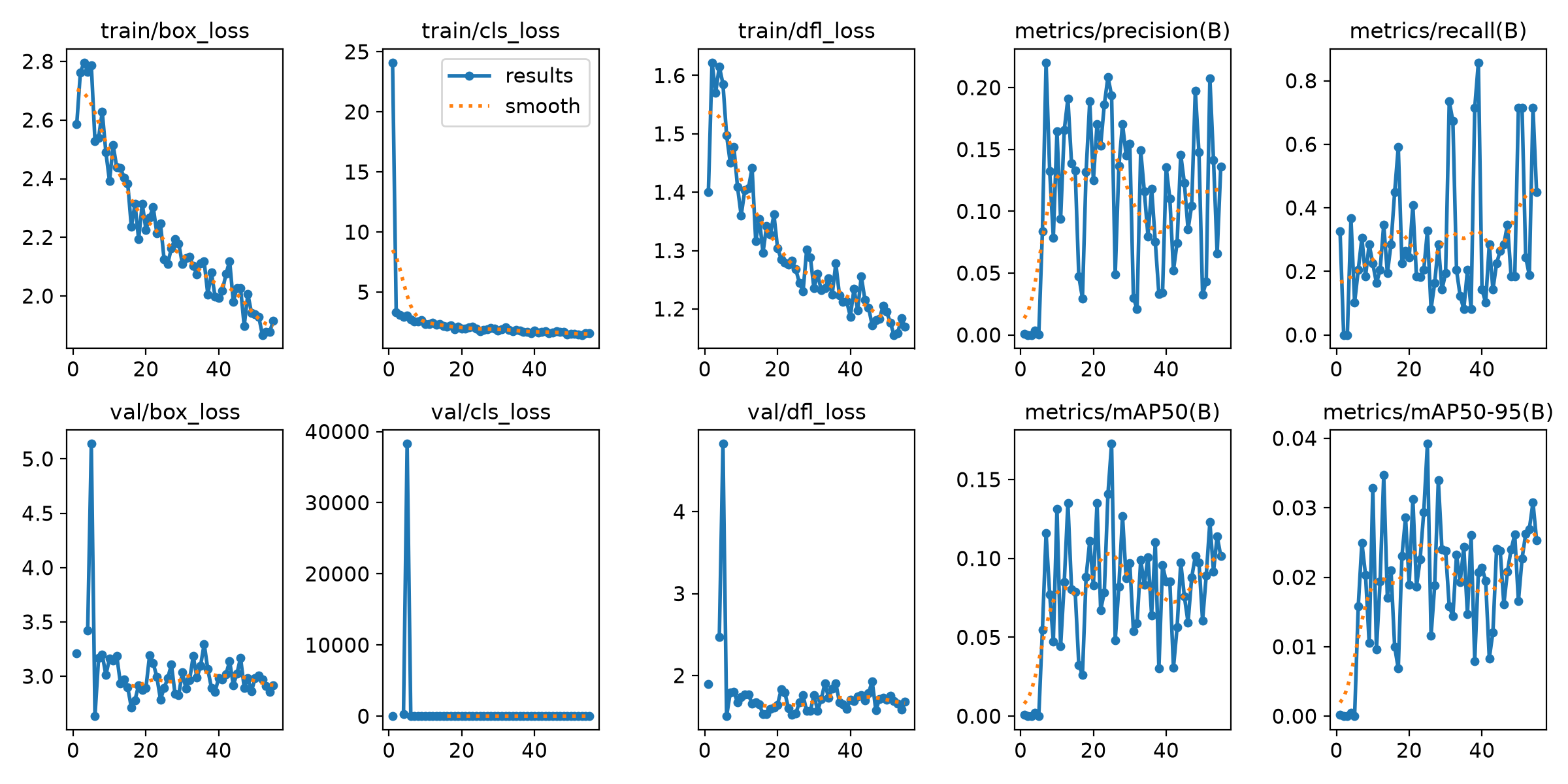
Modest, from 589 training boxes. Training at the images’ full 1024 px did worse (mAP50 0.02 on the test year): the validation year is small, and early stopping picked an epoch that did not generalize. More labelled data from more surveys helps more than any setting.
"""
Step 2: train the first-stage object detector (Ultralytics YOLO).

Needs ultralytics (and PyTorch) and a GPU; about 10 minutes on one 20 GB card.

Usage: python examples/atr/atr_2_train_detector.py ATR_DIR

See "Target recognition" in the sidescanpy docs for what each step does and its results.
"""

# 2026 rshomberg@uri.edu

import os
import sys
from pathlib import Path

from ultralytics import YOLO

root = Path(sys.argv[1] if len(sys.argv) > 1 else "atr_santos").resolve()
runs = root / "runs"
runs.mkdir(parents=True, exist_ok=True)
os.chdir(runs)  # Ultralytics downloads weights into the working directory

# %%
# Train. Sonar images are not flipped up-down by default in YOLO, and
# shouldn't be (a shadow falls away from the sonar); left-right flips
# mirror port and starboard, which is fine for these one-sided images.

model = YOLO("yolo11s.pt")
model.train(
    data=str(root / "detect" / "data.yaml"),
    imgsz=640,
    epochs=80,
    batch=16,
    patience=30,
    flipud=0.0,
    fliplr=0.5,
    project=str(runs),
    name="detector",
    exist_ok=True,
    seed=0,
    workers=4,
    plots=True,
)

# %%
# Score the best weights on the held-out year.

best = YOLO(runs / "detector" / "weights" / "best.pt")
metrics = best.val(data=str(root / "detect" / "data.yaml"), split="test", imgsz=640,
                   conf=0.05, project=str(runs), name="detector_test", exist_ok=True)
p, r, map50, map50_95 = metrics.box.mean_results()
print(f"test (2017): precision {p:.2f}, recall {r:.2f}, mAP50 {map50:.2f}, mAP50-95 {map50_95:.2f}")